Choose theme
AI Guide
AI Hardware: what you actually need
The useful starting point is the AI task and where its model runs. That can help you decide whether your existing computer is enough before comparing upgrades.
These are suggestions to adapt to your situation. Check important details against current original sources before acting.
Task
Understand the requirement before shopping
Find whether the chosen task runs remotely or on your computer.
Approach
Storage, RAM and VRAM do different jobs
Storage holds files; working memory is needed while a model runs.
Takeaway
Identify the actual limit before changing a part
Compare an observed limit with exact device and software requirements.
The task
What you may find useful
Work out whether the AI task you want to try depends on your own hardware, before comparing parts or spending on an upgrade. For example, separate a local model that will not load from a cloud chat that works normally before treating either as an upgrade question.
Starting point
Before you begin
Identify the app, selected model and exact computer. Cloud services run the model remotely; local software uses your machine. A desktop app may offer both, so inspect the selected connection path.
Try it
An approach you could try
For a cloud chat, first check whether your existing browser or app and connection support the task; a dedicated GPU is not needed just to use the remote service.
For local AI, read the app’s current system requirements and the chosen model’s requirements, then try a small supported model if your existing device meets them.
System RAM is general working memory. A dedicated GPU has VRAM; integrated or unified-memory systems can share memory differently.
Model files occupy storage; loading the model and its working data also needs memory. Free disk space does not mean the model will fit in RAM or VRAM. The text held during a conversation—its context—also uses memory, alongside other open apps.
A compressed model can have a smaller download and use less memory for its weights. One common method, quantization, stores those weights at lower precision; that can change the quality of its answers. Compare the requirements for the actual model version you plan to use.
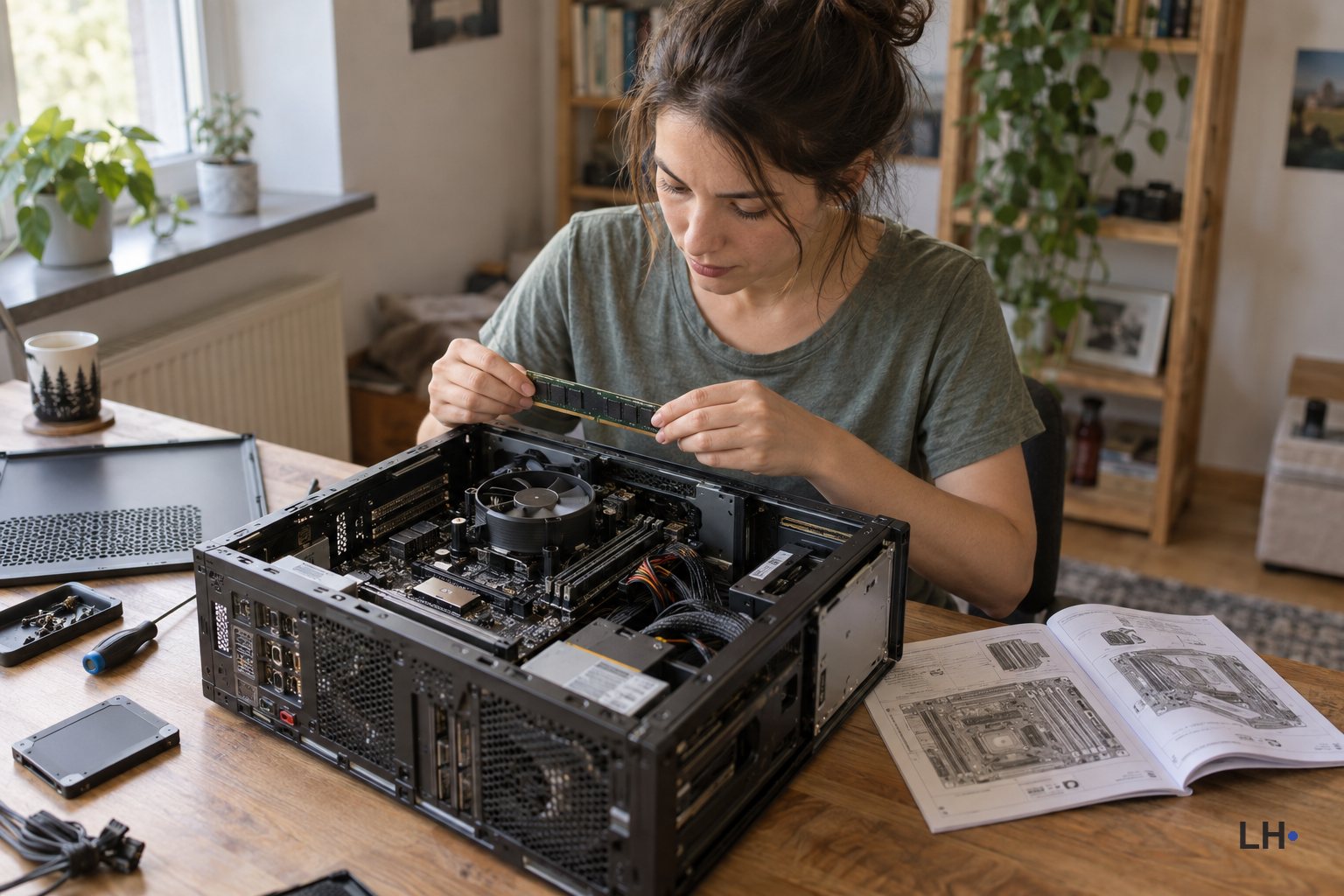
Before considering a part, check the device manual for RAM type and capacity limits. Is the memory replaceable or soldered in, and are there spare slots? Check the storage interface and physical size too.
Check the result
What to check afterward
Did the observed limit come from memory, storage, software support or response speed? More of one component may not fix another limit.
Compare the exact proposed part with the device and software requirements, including supported drivers.
Does the device accept a graphics-card upgrade at all? Some laptops and all-in-one computers do not. For a compatible desktop, check case space, power connectors, power supply and cooling before choosing a card.
Before ordering, compare the seller, warranty and returns alongside the part specifications.
Compare parts
Find the part you’re looking for
Ready to compare options? Start with the part that matches your computer and the limit you found above.
Paid links to Amazon. As an Amazon Associate I earn from qualifying purchases.
These links open Amazon searches so you can compare products and sellers. They aren’t a fitted parts list for your PC.
Next step
Where to go next
You could continue with local/private AI tools once you know which setup your device supports. If your current task works through a cloud service, you may already have the computer you need.
AI Guide note
How to use this guide
AI Guides are general editorial guidance, not professional advice or guarantees about accuracy, safety, suitability, performance, or outcomes. Tools, terms, prices, features, and laws can change. Check important details against original sources, product terms, reliable references, and qualified help where needed.
Source trail
Check the app and model requirements
For local AI, start with the app you want to use and the model you want to run. These references explain supported systems and how model compression affects memory.
What to explore next
Match the hardware to a local AI path
Move from the decision guide into hardware collections, then compare the local tools and runtime the computer needs to support.