Theme
AI Guide
AI Models vs AI Agents: Why the Setup Matters
An AI model is not always the whole story. The same model can feel simple in one app and much more capable in another, depending on the setup around it.
Use this guide as a starting point, then check important decisions against your own needs, reliable sources, and qualified help where needed.
Main idea
A model answers. An agent works through steps.
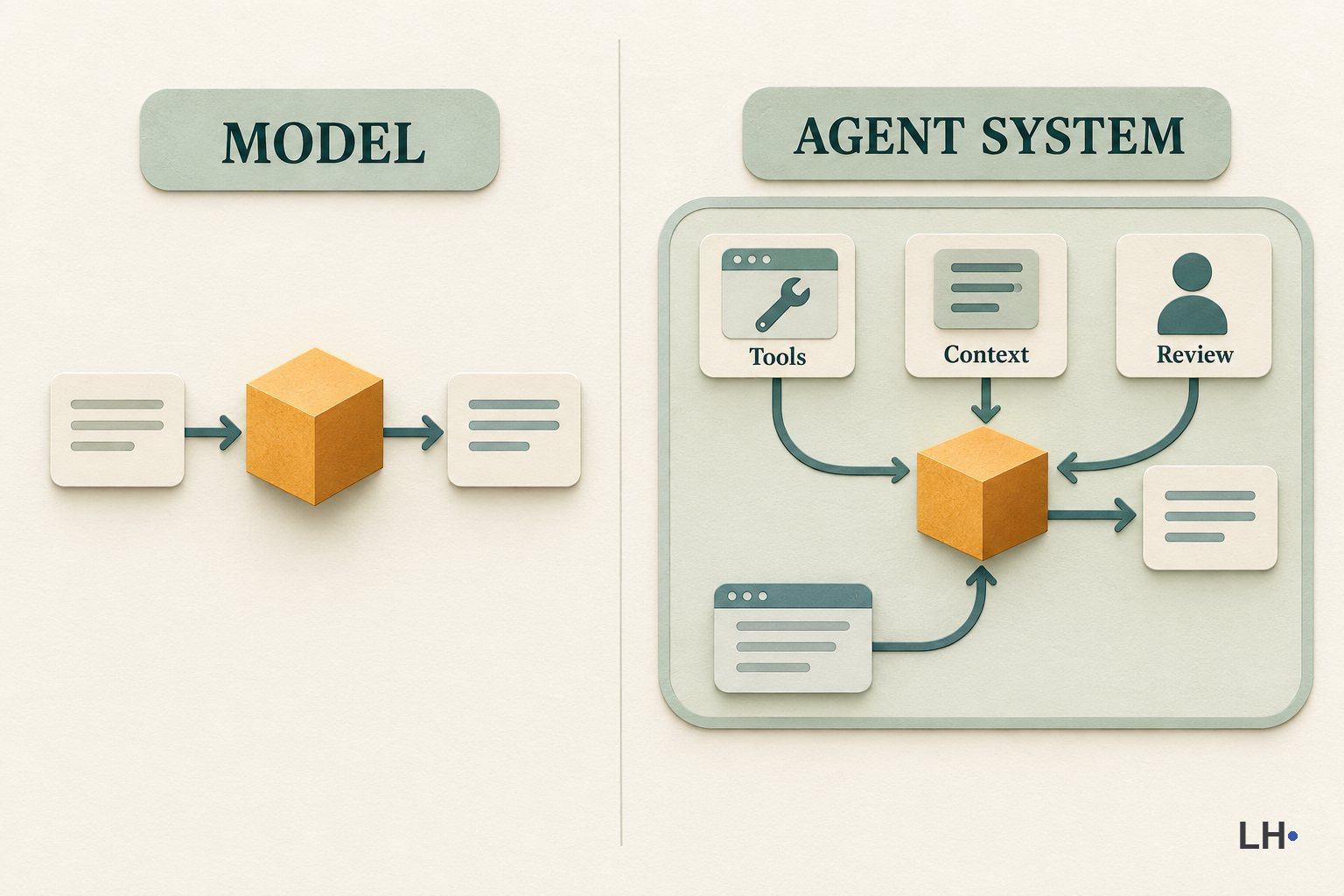
A model usually produces an answer or output. An agent wraps a model in a process that can plan, use tools, check results, and continue across multiple steps.
Why it matters
The setup changes the capability.
Even if the model itself is unchanged, better tools, memory, instructions, and feedback loops can make the whole system much more useful.
Careful reading
Agent does not mean AGI.
An agentic system may be more capable than a simple chatbot, but that does not automatically mean it is conscious, safe, unsafe, or generally intelligent.
Start here
The model is not always the whole system
When people talk about AI, they often focus on the model name. That makes sense. Models matter a lot. A stronger model may reason better, write better, code better, or handle more complex instructions.
But once AI is used inside real products, the model is only one part of the system. A chatbot, a coding assistant, a research tool, and an automation agent may all use a language model underneath.
What changes is the setup around that model: the instructions it receives, the information it can access, the tools it can use, whether it can keep state, and how many steps it can take before stopping.
That is why "what model is it?" is only the first question. A better second question is: "What is the model allowed to do?"
Does it only reply in chat, or can it use tools?
Can it search, read files, run code, or edit a project?
Does it keep state across steps?
Does it check results before continuing?
Does it pause for human review before important actions?
The model
What is an AI model?
An AI model is the base system that turns input into output. For a language model, the input might be a prompt, a document, a question, or a chunk of code. The output might be an answer, summary, plan, translation, or code suggestion.
A model can be very capable, but by itself it usually does not know your private files, your live app state, your calendar, your database, or what happened after its last response. It also does not automatically take action in the world unless a surrounding application gives it a tool or permission to do so.
A simple way to think about it: the model is the engine, while the product around it is the vehicle. The engine matters, but the vehicle determines whether it feels like a writing assistant, a coding tool, a research workflow, or something closer to an agent.
How good is the model at reasoning?
How well does it write?
How well does it code?
How large is its context window?
What kinds of files or inputs can it understand?
The agent
What is an AI agent?
An AI agent is usually a system that uses a model to work toward a goal across steps.
There is no single perfect definition. Different companies and researchers use the word differently. Some use "agent" for highly autonomous systems. Others use it for more controlled workflows where the model has limited freedom inside a fixed process.
For everyday readers, the useful distinction is this: a chatbot responds, while an agent can continue.
An agent may break a task into smaller parts, choose tools, inspect results, retry when something fails, and decide what to do next.
Goal: what the system is trying to complete.
Instructions: how it should behave and what rules it should follow.
Tools: search, file access, code execution, APIs, databases, or other services.
Memory or state: what it keeps track of while working.
Loop: observe, think, act, check, continue.
Limits: stopping rules, permissions, human review, and safe defaults.
Simple comparison
Models, workflows, and agents
A model is best understood as the base capability. A workflow is a structured process around the model. An agent is a more flexible system that can work toward a goal across steps.
This is not a ranking. It is a fit question.
Model: usually responds to a prompt, without necessarily acting outside the chat.
Workflow: follows a predefined series of steps, which can make it easier to predict and review.
Agent: works toward a goal across steps and may choose tools or decide what to do next.
Model-first questions ask how capable the base model is.
Agent-first questions ask what the whole system can access, remember, do, and review.
The setup
Why the setup around the model matters
The setup around a model is sometimes called a scaffold, wrapper, harness, or agent architecture. The name is less important than the idea: the model is being placed inside a larger system.
That larger system can change what the AI is able to do. A single model call may produce one answer. A stronger setup may ask the model to draft, check sources, call a tool, inspect the output, and try again.
The model did not necessarily change. The workflow changed.
That is why two products can use similar models and still feel very different. One may give the model a chat box. Another may give it a project folder, search tools, memory, structured instructions, and review gates.
From the user's point of view, that can feel like a different level of capability. Sometimes the model is different. Sometimes the surrounding system is doing more.
What tools does this app give the model?
What context does it provide?
How does it handle mistakes?
Can the user review actions before they happen?
Can it be stopped or corrected easily?
Loops
How agents work through steps
The shift from model to agent is not just "better answers." It is connecting AI output to action across a task.
A model may say what it would do. An agent may be able to do part of it.
That can be helpful for tasks where the next step depends on the result of the previous step. For example, a model may write a search query, read the results, notice that the answer is incomplete, search again, compare sources, and then produce a clearer summary.
More loops do not automatically make an AI correct. They can also repeat mistakes or chase the wrong direction. But when the task is well-scoped and the feedback is useful, loops can help the system inspect, act, and adjust.
That is why stopping rules and human review matter. A useful agent should know when to continue, when to ask, and when a person should review the next action.
Receive a goal.
Make a plan.
Choose a tool.
Observe the result.
Update the plan.
Continue, ask, or stop.
Careful claims
What this does not mean
Agentic AI is worth understanding, but it is easy to overstate what it proves.
An agent is not automatically AGI. An agent is not automatically conscious. An agent is not automatically safe or unsafe. An agent is not automatically better than a simpler tool.
Sometimes a simple chatbot answer is enough. Sometimes a fixed workflow is better than an open-ended agent. Sometimes adding more autonomy only adds cost, latency, and ways for the system to go wrong.
A practical way to read agent claims is to look at what the system actually did, how much help it needed, what tools it used, and whether the result could be checked.
What task did it complete?
How much human help did it need?
What tools did it use?
Was the environment controlled or real-world?
Could the result be checked?
What happens if the agent makes a mistake?
Reading AI news
How to read future agent news
When you see headlines about AI agents, try not to start with "Is this AGI?"
Start with simpler questions. They make agent news easier to understand and keep the discussion useful without turning every story into hype or panic.
The real lesson is simple: the model matters, but the whole system matters too.
What did the agent actually do?
Was it one step or many steps?
Did it use tools?
Did it remember anything across the task?
Did it act in a real environment or a test setup?
Was there human approval?
Were failures reported, or only the best result?
Would a simpler workflow have done the same job?
Takeaway
The useful takeaway
AI models are the foundation. AI agents are what happens when models are placed inside systems that can plan, use tools, keep state, and continue across steps.
That does not make agents magic. It does make the setup around the model worth understanding.
For curious readers, the key is to watch the tools, memory, permissions, feedback loops, human review, and the kind of task being attempted.
AI Guide note
How to use this guide
AI Guides are general editorial guidance for reference, not professional advice or promises about accuracy, safety, suitability, performance, or outcomes. Tools, terms, prices, features, and laws can change. Check important details against original sources, product terms, reliable references, and qualified help where needed.
Source trail
Further reading
This guide is a plain-English starting point. These links give supporting context on agentic systems, tool use, and long-horizon AI tasks.
Anthropic - Building effective agents
Google Cloud - What are AI agents?
ReAct paper - Synergizing Reasoning and Acting in Language Models
METR - Measuring AI Ability to Complete Long Tasks
LifeHubber AI Radar - AI Agents Can Self-Replicate in a Lab - Here's What That Actually Means
LifeHubber AI Radar - AI Cyber Access Is Becoming a Trust Question - Here's Why It Matters
Get occasional updates when new AI resources are added
Occasional notes when new AI resources are added. The form below is handled by the mailing-list service, so its own terms apply when you subscribe.
Related in LifeHubber
Continue browsing
When you are ready to keep going, try AI Guides for help with choosing and using AI tools well, AI Resources for more tools and projects to explore, AI Access for free and low-cost ways to compare AI model access, AI Ballot for a clearer view of what readers are leaning toward, and AI Radar for timely AI stories and useful context.