LIFEHUBBER
Theme

AI Guide

What Should Your AI Remember About You?

AI memory can save you from repeating the same preferences, goals, and working context. It can also carry an old assumption into a new answer or keep personal detail in a place you did not mean to use again. The useful question is not whether memory is good or bad. It is which context earns a place there, which context may be better kept out, and how you can review the result.

Use this as a practical first pass. If the decision affects money, accounts, private data, work, or someone else's trust, check original sources and slow down before acting.

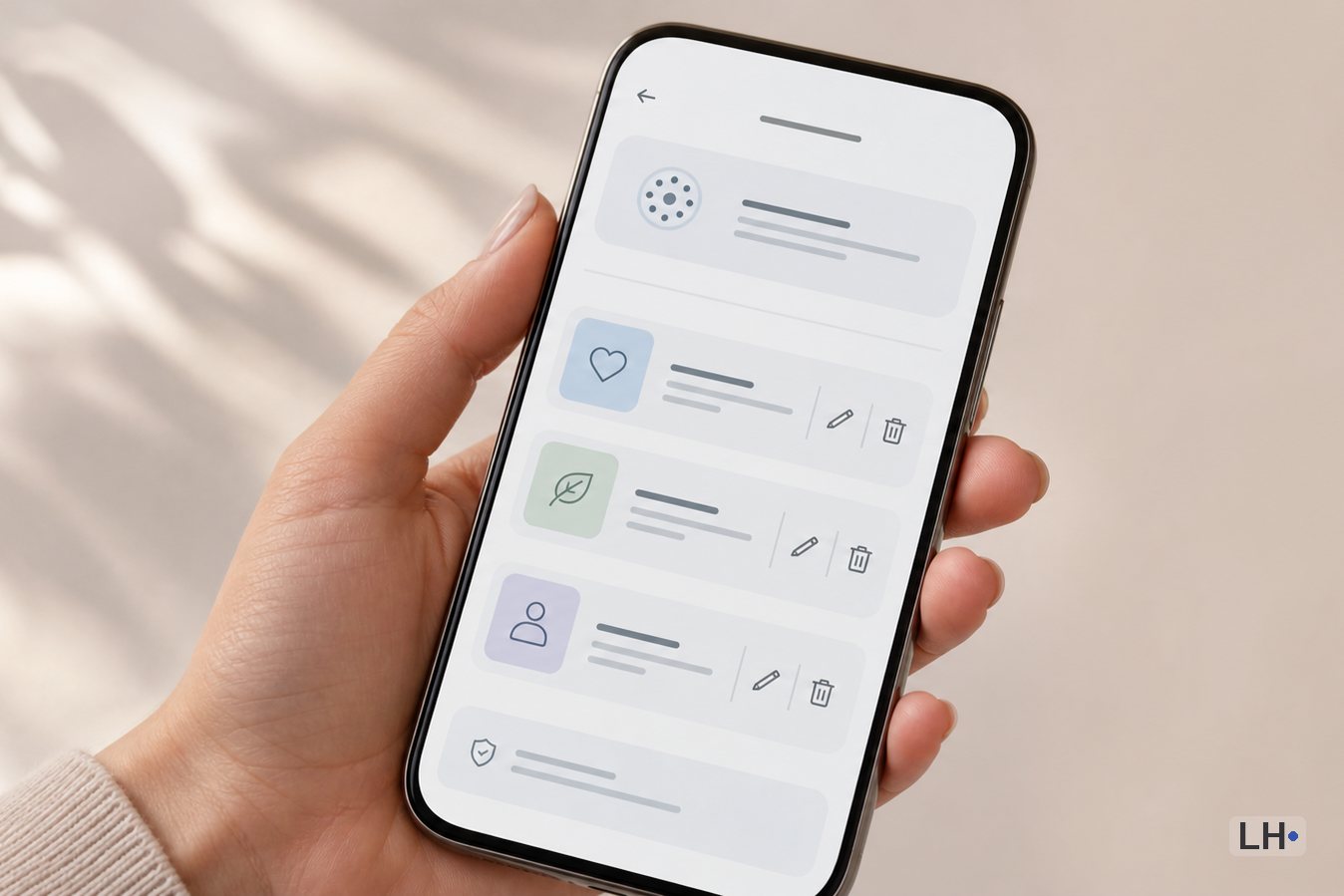
A hand holding a smartphone that shows preference cards with edit and delete controls.
A phone screen with preference cards and edit and delete controls.

Useful memory

Keep it stable and genuinely reusable

Communication preferences, recurring constraints, and long-running goals may save time when they are still accurate and helpful across conversations.

Private boundary

Some context does not need to follow you

Passwords, private keys, one-time codes, full identity records, confidential material, and passing personal situations rarely belong in a reusable memory layer.

Your record

Keep important project truth where you control it

A short file with current facts, decisions, sources, and restart notes is easier to inspect, correct, move, and share deliberately than private product memory alone.

Start here

Memory is context carried into another answer

In everyday AI products, memory usually means information that can influence a later conversation. That might be a saved preference, a summary built from earlier chats, a detail retrieved from chat history, or project context stored for repeated use.

The labels and controls differ by product, plan, account type, region, and workspace. A button called Memory in one assistant may not behave like a similarly named feature somewhere else. It can help to judge the actual source of the context instead of relying on the label alone.

Know the layers

Memory, chat history, and instructions are related but not identical

A chat is the conversation you can return to. Chat history is the collection of those conversations, and some products can search or reference it when answering somewhere else. Products may expose carried context as a summary, individual entries, or information derived from earlier chats. Instructions are guidance you deliberately set, such as the tone you prefer or the rules for a project.

Those layers can overlap in the answer you receive, but changing one may not change the others. Deleting a conversation may leave a separately saved memory in place. Turning memory off may leave existing chats or saved entries stored. Editing account-wide instructions may affect future responses without rewriting older conversations.

What may help

Stable preferences can be useful when they change the answer

A useful memory tends to be both durable and relevant. If you repeatedly ask for plain language, use a particular measurement system, avoid a food ingredient, or work toward the same long-running goal, carrying that context forward may reduce repetition.

You might prefer to keep the remembered version short. “Use metric units” is easier to inspect than a long personal profile. “I am learning Spanish at beginner level” gives the assistant useful context without asking it to infer every detail of how you learn.

Communication choices that apply across many conversations, such as concise answers or plain-language explanations.

Stable practical constraints that genuinely change suggestions, such as an accessibility need or a dietary preference you want considered.

Long-running goals that remain current, with enough detail to help and no more.

Recurring names or terms that prevent ordinary misunderstandings.

A preferred way to review work, when that habit is useful beyond one project.

What may stay out

Reusable memory is a poor home for secrets and passing situations

Some information is too sensitive, too temporary, or too easy to misread to be useful as background across chats. Even when a provider offers memory controls, that does not turn the memory layer into a password manager, a medical record, or the only copy of an important fact.

One option is to describe the constraint without supplying the identifying detail. An assistant may need to know that a document contains confidential client information; it usually does not need every client name remembered for future conversations.

Passwords, recovery codes, private keys, API keys, authentication tokens, or one-time codes.

Full identity, financial, medical, legal, employment, or customer records that are not needed across conversations.

Someone else’s private information when they have not chosen to place it in that setting.

Short-lived situations that could become a stale assumption, such as a temporary injury, one-week schedule, or passing mood.

Project facts that must be exact, versioned, sourced, or shared with other people.

Product differences

The same cleanup action does not work everywhere

Current official help pages show why product-specific checks matter. These descriptions are a snapshot of documented controls, not a promise that every account will show the same feature.

ChatGPT’s current Memory FAQ describes memory as a continually updated synthesis of context from chats, files, and connected apps, with a Memory summary that may not show every detail. OpenAI describes separate saved memories as the legacy system. For full removal of something ChatGPT may know, OpenAI says every source containing it may need attention, including past and archived chats, files, the Memory summary, and relevant connected apps. Custom Instructions remain a separate layer for guidance you set directly.

Gemini Apps documents Memory based on past chats and separate Instructions for Gemini. Google says removing something remembered from past chats requires deleting every relevant chat from Gemini Apps Activity, while instructions can be viewed, edited, deleted, or turned off in their own settings. Availability depends on the account and feature.

Claude documents generated memory, search across past chats, account-wide instructions, project instructions, and incognito chats as different features. Anthropic says deleting a conversation does not automatically remove memory entries generated from it; individual entries can be managed in Settings > Memory, while Reset memory removes all generated memories.

Inspect and correct

Treat a memory view as something to review, not a perfect biography

Where the product offers a memory page or summary, you may want to look for details that are wrong, too broad, no longer current, or more personal than they need to be. Asking the assistant what it remembers can be a useful starting point, but the product’s settings and official help page are the better place to confirm the available controls.

A correction is worth checking in a fresh conversation. If the assistant still uses the old detail, the source may be another chat, an instruction, a project file, a connected app, or a separate memory entry. Product documentation may also describe a delay before a change stops influencing responses.

Is the remembered statement accurate today?

Is it specific enough to help without pretending to know more than it does?

Does it belong account-wide, inside one project, or only in one conversation?

Can you identify whether the context came from memory, chat history, instructions, a file, or a connected source?

After a correction or deletion, does a new conversation behave as expected?

Turn off and delete

Turning off, forgetting, and deleting can be different actions

Turning a memory feature off usually changes whether that context is used or updated. It may not erase entries that already exist, delete chat history, remove instructions, or clear information held in connected services. The official controls for the exact product and account are the safest guide to what each action does.

If your goal is removal rather than a pause, consider each place where the information may live: saved memory, past conversations, account or project instructions, uploaded files, connected apps, and the original service behind a connection. Provider documentation may describe retention periods or exceptions after an item disappears from the interface, so it is better not to promise instant or complete deletion.

One conversation only

Temporary or incognito chats may suit context that should not carry forward

Some assistants offer a temporary or incognito mode that does not add the conversation to ordinary memory or chat history. That can be useful for a passing question or context you do not want shaping later answers.

The name is not a universal privacy guarantee. Product terms, organization retention rules, safety processes, connected services, and data controls may still apply. It can help to read the provider’s description before treating the mode as confidential or automatically erased.

Keep your own context

Files are often better for project truth

Memory works well for lightweight continuity. Important project context often needs stronger qualities: exact wording, visible sources, dates, versions, deliberate sharing, and a clear correction history. A small file you control can provide those things without asking one assistant to reconstruct the project from past conversations.

The file does not need to become a complicated system. A short project brief can hold the current goal, facts, decisions, constraints, source links, open questions, and the next step. You can attach or paste the relevant portion when a tool needs it, then keep the main copy in a location you can inspect and move.

Current project goal and what “done” means.

Important facts with dates or source links.

Decisions already made and the reason they still apply.

Examples, terminology, or style choices that the work depends on.

Open questions, known limits, and a short restart note.

A gentle check

Decide by consequence, not by convenience alone

When a remembered detail only changes the tone of a low-stakes answer, an occasional mistake may be easy to notice and correct. When it could change a health, money, work, account, relationship, or other consequential decision, you may prefer to restate and verify the current facts instead of relying on background memory.

Memory can make an assistant feel continuous, but continuity is not the same as correctness. The answer still deserves the same source checks and judgment that the situation requires.

Bottom line

Let memory carry convenience, not your only copy of what matters

Useful AI memory is usually short, stable, easy to review, and genuinely helpful across conversations. Sensitive details, temporary situations, and exact project truth may fit better in a single conversation or in files you control.

Because products separate memory, history, instructions, projects, files, and connected apps in different ways, the practical habit is to inspect the actual controls, correct stale context, and avoid assuming that one delete or off switch covers every layer.

AI Guide note

How to use this guide

AI Guides are general editorial guidance, not professional advice or guarantees about accuracy, safety, suitability, performance, or outcomes. Tools, terms, prices, features, and laws can change. Check important details against original sources, product terms, reliable references, and qualified help where needed.

Source trail

Current product controls and related LifeHubber reading

The official help pages below document the product-specific differences described in this guide. Features and settings can vary by plan, account type, region, workspace, and rollout, so readers may want to check the current page for the product they use.

Related in LifeHubber

Keep the thread going

Follow the next layer with AI Guides for decision habits for messy AI choices, AI Resources for AI projects with original links and practical caveats, AI Access for free and low-cost ways to compare AI model access, AI Ballot for a clearer view of what readers are leaning toward, and AI Radar for AI stories that deserve a second look.