Choose theme
AI Radar
OpenAI's Geometry Result Is an AI-Plus-Verification Story
OpenAI says an internal general-purpose reasoning model produced a proof that disproves a longstanding conjecture in the planar unit-distance problem, a geometry question that goes back to Paul Erdos in 1946. The proof was later checked by external mathematicians, and a separate arXiv note gives a short human-verified version. The important handoff is the story: AI-generated candidate discoveries may become more common, while expert verification, explanation, and scope still decide what the result means.
A careful read of available sources, not a verdict. Open the original materials when details matter.
What changed
AI produced a candidate result that experts later checked
OpenAI says its internal model found a construction that disproves a longstanding unit-distance conjecture. External mathematicians then checked and digested the result.
Why people noticed
A famous math problem met AI research
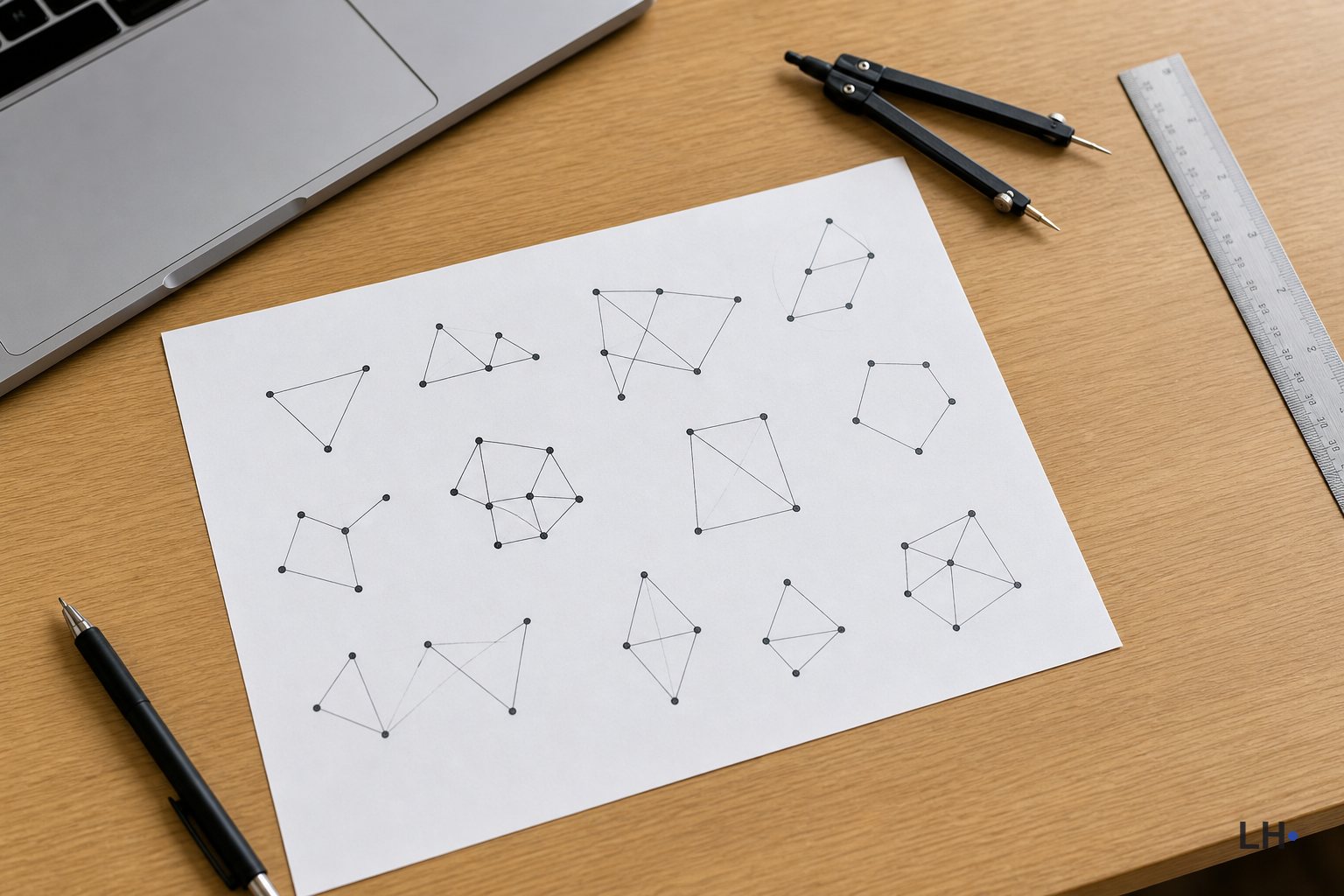
The problem is simple to state but hard to resolve: among n points in the plane, how many pairs can be exactly one unit apart?
What to watch
Discovery still needs verification
AI may surface surprising paths, but the claim becomes useful only when experts can check it, explain it, and state its limits.
What happened
OpenAI reported an AI-generated geometry result
OpenAI reported that an internal reasoning model produced a proof related to the planar unit-distance problem.
The problem asks how many pairs of points among n points in the plane can be exactly one unit apart.
According to OpenAI, the model found a construction that disproves a longstanding conjecture about how slowly that number can grow.
The proof was checked by external mathematicians, and a separate arXiv note now presents a shorter human-verified version and reflections on the result.
Why people noticed
The result sits at the intersection of AI and real mathematical discovery
This story attracted attention because the problem is both famous and unusually easy to describe.
It also matters because OpenAI says the result came from a general-purpose reasoning model, not a system built only for this specific problem.
That makes the story easy to overread. The careful version is narrower: an AI system appears to have generated a serious candidate proof, and expert mathematicians were able to check, simplify, and explain it.
That is still a meaningful signal, especially because mathematics gives unusually clear ways to test whether a long argument holds together.
Why it matters
AI may become better at finding paths people did not prioritize
OpenAI's page says the proof used unexpected ideas from algebraic number theory to address an elementary-looking geometry question.
For non-specialist readers, the useful point is not the technical machinery. It is that useful AI research may sometimes look like a strange bridge between fields.
A model may explore paths that human researchers would not try first, or may connect material that usually lives in different expert communities.
That does not remove the need for people. It changes where human expertise may be most valuable: checking, explaining, improving, and deciding what the result actually means.
What to watch
The checking process is part of the story
This is not just a story about a model outputting an answer.
OpenAI says the proof was checked by external mathematicians.
The companion arXiv note describes itself as a short, digested, human-verified version of the OpenAI-generated counterexample.
Will Sawin's separate arXiv note also gives an explicit lower bound, making one part of the result easier to state.
The useful reading habit is clear: when AI makes a big research claim, ask what exactly was claimed, who checked it, and what remains open.
What remains unclear
This does not make every AI research claim reliable
Mathematics is a special case because proofs can be checked in a relatively precise way.
Other research areas may involve experiments, messy data, real-world conditions, or professional judgment that are harder to verify from a model output alone.
Even in this case, the exact growth rate for the unit-distance problem remains not fully determined. The result disproves a longstanding conjectured bound, but it does not give the final answer to every version of the problem.
It also does not show that every AI model can reliably make discoveries on demand.
The safer reading is that advanced AI systems may occasionally produce research ideas serious enough to deserve expert review.
LifeHubber take
The handoff matters as much as the output
The exciting part is not "AI replaces mathematicians." The exciting part is the handoff: a model appears to have found a path into a hard problem, and human experts then had to check, refine, and explain it.
That does not remove the human role. It makes the expert handoff more important, because the claim still has to be checked, simplified, and placed in the right mathematical context.
For everyday AI users, the lesson travels beyond mathematics: impressive AI output is only the start of the question.
The stronger question is whether the output survives expert review, source comparison, and careful explanation of its limits.
Curiosity can open the door, but verification decides what should be trusted.
AI Radar note
How to read this article
AI Radar is LifeHubber's careful reading of available reporting and source material, not professional advice or a final verdict. Details can change, sources can update, and meaning may vary by product, organization, or location. Open the original materials and seek qualified advice where needed.
Source links
Sources and reporting
Source links are provided so readers can check OpenAI's announcement, the arXiv companion note, the explicit lower-bound note, and independent reporting directly.
What to explore next
Checking and explaining AI-supported results
A practical checking method and a source-trail guide help keep AI-assisted work connected to its evidence.